
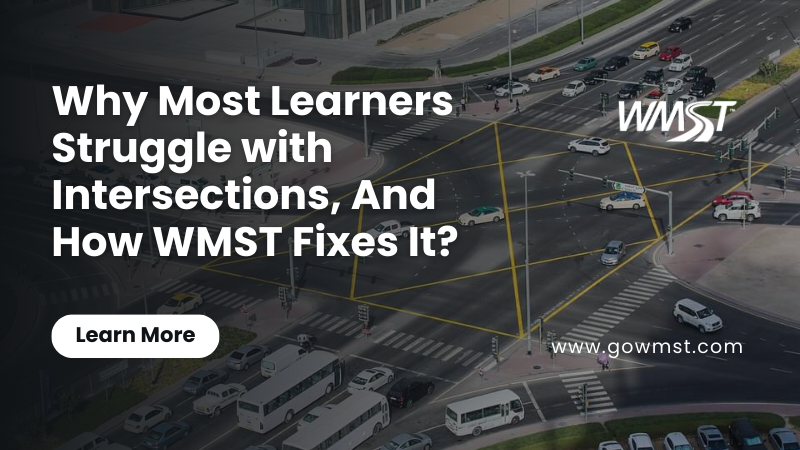
Navigating intersections safely is statistically one of the hardest skills for new drivers to master. In fact, “Failure to Yield” is a leading cause of automatic failure on the Washington State Skills Test.
Why are intersections so difficult? They are dynamic environments where the rules change based on timing, signals, and the presence of other road users. For a learner driver, processing all this information at 30 mph can be overwhelming.
At WMST, we believe that confusion is just a lack of training. By breaking down intersection driving lessons WA students need into clear, manageable steps, we turn anxiety into confidence. This guide explains why intersections trip up so many learners and how you can master the right-of-way intersections demand.
The Most Confusing Types of Intersections for New Drivers
Not all intersections are created equal. While a simple two-way stop is straightforward, other layouts cause significant “brain freeze” for learners.
- Uncontrolled Intersections: These residential intersections have no signs or signals at all. New drivers often assume they can just drive through, not realizing they must yield to the vehicle that arrives first or to the right in the event of a tie. In some uncontrolled intersections, the vehicle on the major thoroughfare will have the right-of-way over those on the minor road.
- The “Flashing Yellow” Left Turn: Understanding that a flashing yellow arrow means “you can turn, but you must yield to everyone else first” is a common stumbling block.
- Multi-Lane 4-Way Stops: When two cars arrive side-by-side, or four cars arrive at once, the “First Come, First Served” rule gets complicated quickly.
Visit: Smart Driving Habits That Save Money on Gas in 2026
Understanding WA Right-of-Way Rules
To pass your test, you cannot guess; you must know the law. Washington State RCWs (Revised Code of Washington) are specific about who goes when.
- The “Yield to the Right” Rule (RCW 46.61.180): At a 4-way stop or uncontrolled intersection, if two vehicles arrive at the same time, the driver on the left must yield to the driver on the right.
- The “Straight Over Turning” Rule: If you are turning left and an oncoming vehicle is going straight, and you both arrive at a stop sign simultaneously, the vehicle going straight has the right-of-way.
- Pedestrians Rule Supreme: You must always yield to pedestrians in a crosswalk, whether it is marked with paint or unmarked at an intersection.
How to Make Safe Left and Right Turns Every Time
Left turn safety WA examiners look for is about judgment. A “protected” left turn (Green Arrow) is easy. An “unprotected” left turn (Green Circle) is where mistakes happen.
- The Green Circle Rule: You must yield to oncoming traffic, pedestrians and bicycles and should not enter the intersection until you can safely clear it.
- Right on Red: You can turn right on a red light in WA, but only after a complete stop. Rolling through a red light to make a right turn is an automatic fail.
- Blind Spots: Before making any turn, you must perform a “head check” (chin to shoulder) to ensure a cyclist isn’t in your blind spot.
How WMST Teaches Intersection Scanning & Timing
We don’t just teach you the rules; we teach you how to see. WMST behind-the-wheel training emphasizes a specific scanning technique that creates time and space.
- L-R-L Scanning: Before entering any intersection, we train students to look Left, Right, and then Left again. The second look to the left is crucial because that is where the closest danger comes from.
- Gap Analysis: Our instructors teach you how to determine the speed and distance of approaching vehicles. This active coaching builds the intuition needed to judge safe gaps.
- Stalemate Solutions: We teach you how to communicate with other drivers (using signals, eye contact, car position, wheel turn, etc.) to resolve confusion at busy 4-way stops safely.
Frequently Asked Questions (FAQs)
Why are intersections the hardest part of driving?
They require split-second decision-making. You must simultaneously assess traffic signals, road signs, oncoming vehicle speed, and pedestrians, all while controlling your own car.
How do I know who goes first at a 4-way stop?
The rule is “First in, First out.” The first vehicle to come to a complete stop gets to go. If you arrive at the exact same time as another driver, yield to the vehicle on your right.
When can I turn left on a green light?
If you have a solid green circle (not an arrow), you can turn left only when the oncoming lane is clear of vehicles and pedestrians. You do not have the right-of-way.
Does WMST offer intersection-focused lessons?
Yes. If you struggle specifically with intersections, you can request that your instructor focus your lesson on navigating complex stops, roundabouts, and traffic lights.
How do I avoid hesitation while turning?
Hesitation usually comes from uncertainty. By memorizing the right-of-way rules and practicing scanning (L-R-L), you will recognize “your turn” faster. WMST instructors help build this confidence through repetition.
 EN
EN  ES
ES  RU
RU  FR
FR  JA
JA  AR
AR  VI
VI