
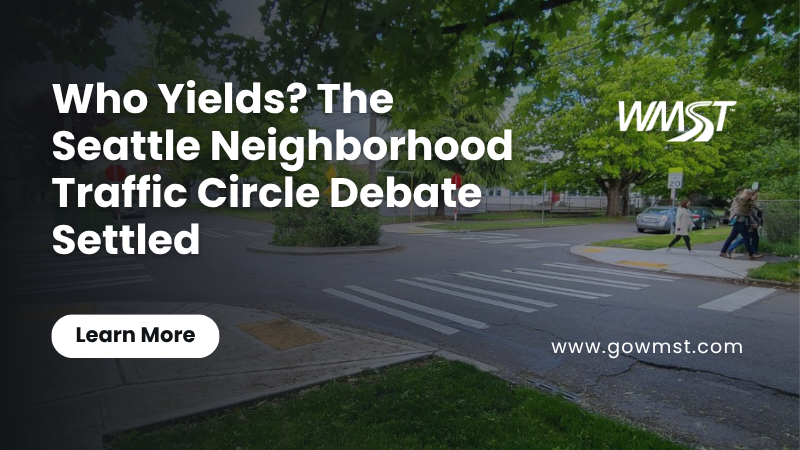
If you drive through the residential neighborhoods of Seattle, Ballard, or Tacoma, you encounter them on nearly every block: small, concrete islands planted with trees or shrubs right in the middle of the intersection.
These are neighborhood traffic calming circles. While they are fantastic at slowing down speeders, they are also the source of one of the fiercest debates among Pacific Northwest drivers: Who actually has the right of way?
Do you treat it like a roundabout and yield to the left? Do you treat it like a four-way stop and yield to the right? Can you just turn left in front of it? Here is the WMST guide to understanding the neighborhood traffic circle rules WA state enforces, so you can navigate residential streets safely and confidently.
It’s Not a Roundabout: The Crucial Legal Difference
The biggest source of confusion is the assumption that a neighborhood traffic circle is exactly the same as a modern highway roundabout. While they are both circular, they operate under different right-of-way rules.
- The Roundabout: A modern roundabout (like the large ones on state highways) will always have clearly posted YIELD signs at every entrance. Because of these signs, you must yield to traffic already circulating inside the roundabout (coming from your left).
- The Traffic Circle: Most neighborhood traffic circles in Seattle are uncontrolled intersections. There are no stop signs and no yield signs. Because there are no traffic control devices, you cannot use the “yield to the left” roundabout rule.
Visit: The 2026 Teen Driving Crackdown: What Washington Parents Need to Know
The “Yield to the Right” Rule Explained
If there are no yield signs at a neighborhood traffic circle, how do you know who goes first? You fall back on the standard Washington State law for uncontrolled intersections.
- The Law: Under RCW 46.61.180, when two vehicles approach an uncontrolled intersection at approximately the same time, the driver on the left must yield the right of way to the vehicle on the right.
- The Application: This means if you pull up to a traffic circle and another car pulls up at the same time to your right, they have the right of way. You must wait for them to enter the circle first.
- The Exception: Just like at a four-way stop, the first car to arrive at the intersection generally has the right of way to proceed, regardless of which direction they are coming from.
The Left Turn Loophole: Do You Have to Go All the Way Around?
Under strict Washington State law, all vehicles must drive counter-clockwise (to the right) around a rotary traffic island. However, the Seattle Department of Transportation (SDOT) acknowledges a practical “loophole” for tight residential streets.
- The Problem: Many residential streets are narrow, and cars are often parked aggressively close to the intersection. If you are driving a large SUV, a moving truck, or towing a trailer, physically turning right to go all the way around the circle to make a left turn might be impossible without jumping the curb.
- The Loophole: SDOT guidelines explicitly state that drivers may turn left in front of the traffic circle if they are driving a larger vehicle or if parked cars block a full rotation.
- The Catch: You can only use this shortcut if you exercise extreme caution and yield to all oncoming traffic, pedestrians, and cyclists. If you cause a collision while turning left in front of the island, you will be found at fault.
How WMST Teaches Defensive Driving in Tight Neighborhoods
At WMST, our WMST city driving modules focus heavily on the unpredictability of residential intersections.
- Anticipate the Shortcut: We teach students to always anticipate the “Left Turn Loophole.” Even if you have the right of way going straight, a driver coming from the opposite direction might suddenly cut left directly in front of the island. Never assume the intersection is clear just because the right side of the circle is empty.
- Scan for Pedestrians First: The shrubbery inside traffic circles creates major blind spots. We train drivers to aggressively scan the crosswalk areas (even unmarked ones) before looking for cars, as pedestrians often step out from behind the vegetation.
Frequently Asked Questions (FAQs)
Who has the right of way in a neighborhood traffic circle?
If the intersection is uncontrolled (no signs), it is treated like a standard intersection: the first car to arrive goes first. If two cars arrive at the exact same time, the car on the right has the right of way.
Do I have to use my turn signal in a small traffic circle?
Yes. You are required to signal your intentions at every intersection. If you are turning left or right, use your signal as you approach the circle. If you are going straight, no signal is needed.
Can I turn left in front of the island instead of going around it?
Technically, state law says you should go counter-clockwise around the island. However, local city guidelines (like in Seattle) recognize that turning left in front of the circle is permissible and safe when driving a large vehicle or when street parking blocks the normal path, provided you yield to all other traffic.
What do I do if a delivery truck is blocking the circle?
Patience is key. If a delivery driver has blocked the lane to drop off a package, you must wait behind them until it is safe to proceed. Do not blindly drive the wrong way (clockwise) around the left side of the circle to pass them, as you risk a head-on collision with oncoming traffic.
Are the rules different if the circle has a yield sign?
Yes! If the city has installed YIELD signs at the entrances to the traffic circle, it legally functions like a roundabout. You must ignore the “yield to the right” rule and instead yield to any traffic already inside the circle (approaching from your left).
 EN
EN  ES
ES  RU
RU  FR
FR  JA
JA  AR
AR  VI
VI