
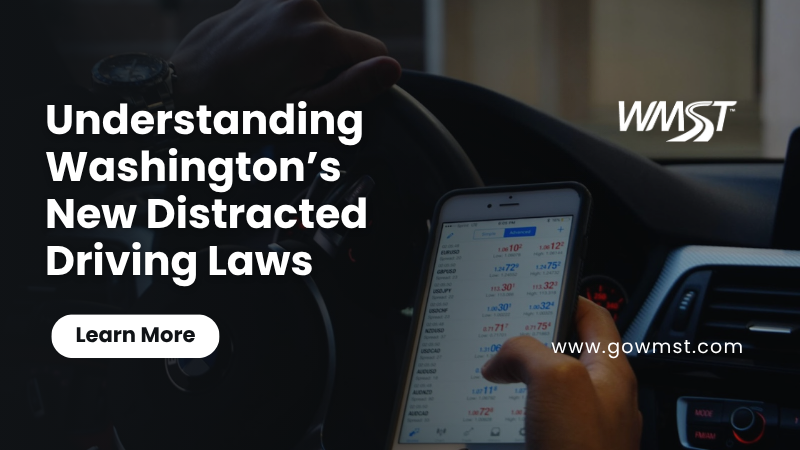
In Washington, a quick glance at a text message or checking your map while holding your phone can land you a serious ticket. In 2017, the state enacted some of the toughest distracted driving laws in WA, and it’s critical for every new driver to understand exactly what the rules are.
The law is commonly known as the “E-DUI” — Driving Under the Influence of Electronics. It treats your phone like any other impairment, and it’s a primary offense, meaning an officer can pull you over just for holding your phone.
Here’s what you need to know to stay safe, legal, and focused behind the wheel.
What Counts as “Distracted Driving” in WA?
Washington law splits distractions into two main categories:
- Using a Personal Electronic Device (The “E-DUI”) This is the primary, most serious offense. It bans holding any personal electronic device while driving. This includes when you are stopped at a red light or in traffic.
- This includes: Holding your phone to talk (even on speaker), text, check social media, watch a video, or take a picture.
- This also includes: Holding a tablet, laptop, or other electronic device.
- Dangerously Distracted Driving This is a secondary offense, meaning you must be pulled over for another reason (like speeding) first. This law covers other non-electronic distractions, such as:
- Eating or drinking
- Personal grooming (like applying makeup or shaving)
- Reading
- Attending to a pet
Fines, Points, and Legal Consequences
This is where the law has serious consequences.
- No “Point” System: First, it’s important to know that Washington state does not use a driver’s license “point” system. Instead, violations are recorded directly on your driving record.
- The Fines (E-DUI):
- First Offense: A fine of at least $136.
- Second Offense (within 5 years): The fine increases to at least $234.
- The Real Cost (Insurance): This is the most significant penalty. An E-DUI violation goes on your official driving record and is reported to your insurance company. This will almost certainly cause your insurance rates to increase significantly, as you are now considered a higher-risk driver.
- License Suspension: An E-DUI is a moving violation. If you get too many moving violations in a short period (for example, six violations in 12 months), the Department of Licensing can suspend your license.
Visit: How to Pass Your Driving Test in the Rain?
How to Stay Focused Behind the Wheel?
The law is strict, but the solution is simple: Go hands-free.
- Mount Your Phone: If you use your phone for GPS, it must be in a dashboard or window mount.
- One-Touch Rule: You are allowed a “minimal use of a finger,” such as a single tap or swipe, to activate or end a function (like answering a call on a mounted device or starting your navigation).
- Set It and Forget It: The safest method is to enter your destination into your GPS before you start driving.
- Use Bluetooth: Connect your phone to your car’s Bluetooth system for calls.
- Pull Over: If you absolutely must send a text or check an email, find a safe and legal place to pull over, park your car, and stop.
WMST’s Emphasis on Focus and Discipline
At WMST, we know that driving is a full-time job. Our entire curriculum is built on the principle of WMST safety awareness and developing the discipline to be a focused driver.
The skills needed to avoid distraction are not just mental; they are physical habits. Our six full hours of actual, behind-the-wheel instruction are designed to build the “muscle memory” of a safe driver. This includes:
- Proactive Hazard Scanning: We train you to constantly scan the road, which is impossible to do when you’re looking at a screen.
- The 4-Second Following Distance: We teach this as our standard for new drivers. This safety buffer gives you the one thing a distracted driver never has: time. Time to react, time to brake, and time to avoid an emergency.
- Zero-Tolerance for Distraction: Our instructors reinforce that a focused driver is a safe driver. We build the habits that make picking up a phone while driving feel as wrong as running a red light.
Visit: How to Read Traffic Flow and Predict Other Drivers’ Moves?
Frequently Asked Questions (FAQs)
Can I use my phone in speaker mode in WA?
Only if you are not holding it. The law is about holding the device. If you are using your phone’s speakerphone while it is in a mount or connected to your car’s hands-free system, it is legal. If you are holding it in your hand, it is illegal.
What’s the fine for texting while driving?
Texting falls under the E-DUI law. It carries a fine of at least $136 for a first offense and goes on your driving record.
Is GPS use allowed while driving?
Yes, but with strict rules. The device must be in a mount, and you can only use a single touch to operate it. You cannot hold the GPS or type in an address while your vehicle is in motion.
Does WMST teach distraction-free habits?
Absolutely. It’s a core part of our curriculum. We go beyond the state-mandated basics to instill habits of discipline, focus, and proactive awareness, the fundamental skills you need to ignore distractions and drive safely.
Are hands-free devices legal in WA?
Yes. Hands-free devices, such as Bluetooth headsets or integrated car systems, are the recommended and legal way to use your phone for calls while driving.
 EN
EN  ES
ES  RU
RU  FR
FR  JA
JA  AR
AR  VI
VI