
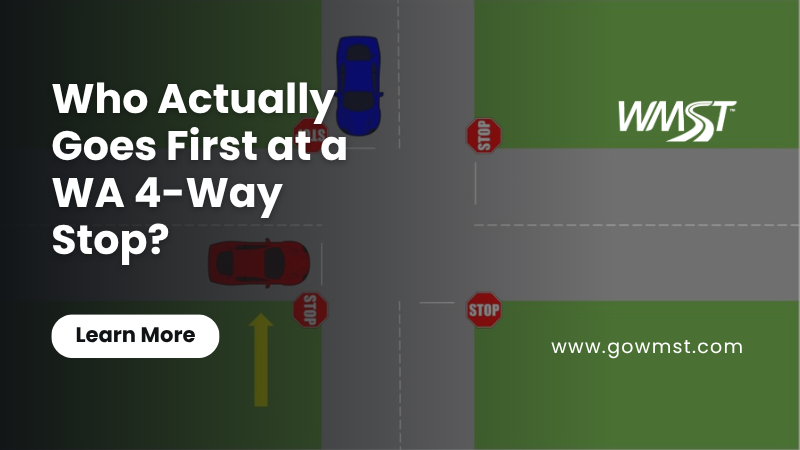
You pull up to a four-way stop at the exact same time as another car. You look at them. They look at you. You both inch forward, hit the brakes, and wave for the other to go. Then, you both hit the gas at the exact same time.
Welcome to the classic Pacific Northwest intersection staredown.
While it’s great that Washington drivers want to be courteous, being “polite” instead of predictable causes confusion, traffic backups, and fender benders. To keep traffic flowing safely and smoothly, the law relies on a strict order of operations. Here is the definitive guide to mastering the 4-way stop right of way WA rules, so you never have to second-guess your turn again.
The Golden Rules: First to Arrive and Yield to the Right
The rules for a four-way stop are actually incredibly simple and rely on two foundational steps.
- Rule #1: First to Stop, First to Go: The right of way always belongs to the vehicle that comes to a complete stop first. It is a strict first-come, first-served system.
- Rule #2: Yield to the Right: If two vehicles arrive and come to a complete stop at the exact same time, the vehicle on the right has the right of way. The vehicle on the left must wait.
This “yield to the right” principle applies broadly across the state. In fact, if you find yourself at a residential corner with no stop signs at all, the unmarked intersection right of way laws dictate that you must also yield to any vehicle approaching from your right.
The “Tiebreaker”: What Happens When Four Cars Arrive at Once?
It is the rarest and most confusing scenario: four cars pull up to all four stop signs at the exact same moment. Since everyone has a car to their right, who goes first?
- The Legal Reality: There is actually no official traffic law in Washington that covers a four-car simultaneous tie.
- The Practical Solution: The tiebreaker at four-way stop scenarios comes down to communication. Make eye contact with the other drivers. Usually, the most assertive driver will slowly inch forward to claim the intersection. Once one car goes, the cycle is broken, and you simply revert to the standard “yield to the right” rule for the remaining three cars.
Turning Left vs. Going Straight: Who Has Priority?
What happens if you and an oncoming car (facing each other) arrive at the exact same time? Since neither car is on the “right,” the rule changes based on where you want to go.
- Straight Beats Left: If you are going straight and the oncoming car is turning left, you have the right of way. The driver turning left must cross a lane of traffic, so they must yield to the driver traveling straight.
- Right Beats Left: If you are turning right and the oncoming car is turning left into the same lane, the right-turning car has the right of way.
- Both Going Straight: If you are both going straight, or both turning right, you can proceed at the exact same time since your paths do not cross.
Visit: Regen Brakes and Auto-Pilot: Driving EVs on Your WA Skills Test
How WMST Breaks the “Overly Polite Driver” Habit
At WMST, we recognize that hesitancy can be just as dangerous as aggressiveness. Our WMST intersection training is designed to build confident, decisive drivers.
- Predictability Saves Lives: We teach our students that driving is about being predictable, not polite. Waving someone through when it is legally your turn disrupts the flow of the intersection and confuses other drivers, pedestrians, and cyclists who are expecting you to move.
- The “Full Stop” Count: We train drivers to feel the car’s weight settle back on its suspension to ensure a complete stop. By securing a clear, legally defined stop, you confidently establish your place in the right-of-way order.
Frequently Asked Questions (FAQs)
What if the power is out at a traffic light?
Under Washington law, a dark or completely out traffic signal must be treated as an all-way stop. You must come to a complete stop and follow the standard four-way stop right-of-way rules.
Does a pedestrian crossing change the order of cars at a 4-way stop?
Yes. Pedestrians in a crosswalk always have the ultimate right of way. If it is your turn to drive but a pedestrian is crossing your path, you must wait for them to clear the lane. Your turn resumes once the crosswalk is safe.
Can two cars facing each other go at the exact same time?
Yes, if they are both traveling straight or both turning right. Because their paths of travel do not intersect, they can legally proceed simultaneously.
What is a “rolling stop,” and how much is the ticket?
A rolling stop (often called a “California stop”) is when a driver slows down but fails to bring the vehicle’s wheels to a complete halt before the stop line. It is illegal and considered a failure to obey a traffic control device, which carries a base fine of approximately $136 in Washington State.
How do I signal my intentions if another driver is hesitating?
If it is your turn but another driver is waving you on or hesitating, make eye contact, nod, and assertively (but slowly) pull into the intersection. If the intersection is governed by flashing red light rules in Washington, you treat it exactly like a stop sign—ensure the other driver actually sees you before proceeding.
 EN
EN  ES
ES  RU
RU  FR
FR  JA
JA  AR
AR  VI
VI