
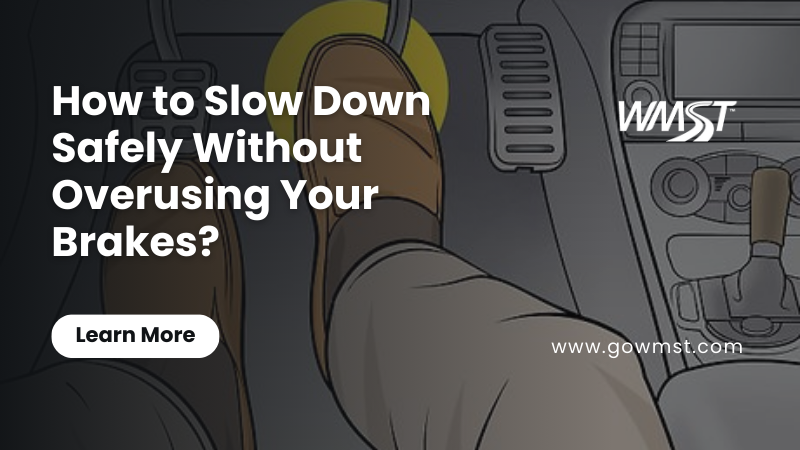
If you watch a professional driver or a seasoned chauffeur, you will notice something interesting: their brake lights rarely flash on the freeway. Instead of constantly switching between gas and brake, they use a technique called “coasting” (or deceleration) to manage their speed smoothly.
In Washington, where traffic can slow down suddenly due to rain or congestion, mastering the coasting driving technique WA roads require is a game-changer. It prevents rear-end collisions, saves fuel, and creates a smoother ride. This guide explains how to effectively manage your kinetic energy and why slowing down smoothly WA examiners prefer is the mark of an advanced driver.
What Coasting Means and When It’s Safe
First, a critical clarification: In this context, “coasting” means reducing the amount of pressure or lifting your foot off the accelerator while the car remains in gear.
Warning: Never coast by shifting your car into “Neutral” (N). According to RCW 46.61.630, coasting in neutral on a downgrade is illegal in Washington State. It disconnects your engine from the wheels, causing you to lose steering control and the ability to accelerate out of danger.
Safe Coasting (In-Gear Deceleration): When you see a red light or brake lights far ahead, you simply lift your foot off the gas. The engine’s natural resistance (engine braking) combined with air resistance will begin to slow the car down immediately, without you touching the brake pedal yet.
How Proper Coasting Improves Control & Smoothness
Treating the brake pedal as your only way to slow down is a “reactive” driving style. Coasting is “proactive.”
- Better Weight Balance: Hard braking shifts the car’s weight violently to the front tires (“nose diving”), which destabilizes the vehicle. Coasting slows the car gradually, keeping the suspension balanced and the tires planted.
- Fuel Economy: Modern fuel-injected cars shut off fuel flow completely when you coast in gear. If you brake, you waste that forward momentum.
- Reduced Wear: Brake management for beginners starts with understanding that every time you use the brakes, you are turning money (gas) into heat and dust. Coasting saves your brake pads for when you actually need to stop.
Visit: Driving on Rural Roads: What City Drivers Need to Know
When to Brake vs. When to Coast
Knowing which tool to use depends on your visual lead time—how far ahead you are looking.
Use Coasting When:
- Approaching a “stale” green light (one that has been green for a long time).
- You see traffic slowing down 15+ seconds ahead.
- Exiting a highway (coast on the ramp before braking).
- Approaching a curve (coast to scrub off speed before entering).
Use Braking When:
- You are within 5 seconds of a complete stop.
- A hazard appears suddenly (pedestrian, deer, cut-off).
- You are on a steep downhill (use brakes to control speed, do not just coast).
- Traffic stops abruptly.
- Just prior to turning into a curve or a turn.
WMST Training for Smart Speed Reduction
At WMST, we teach that smooth driving is safe driving. Our WMST braking lessons focus heavily on “Cover Braking.”
This technique involves lifting off the gas and hovering your right foot over the brake pedal without pressing it. This reduces your reaction time significantly. By teaching students to scan 15 seconds ahead, we help them identify when to coast early, eliminating the need for those panic-inducing “jerky stops” that fail driving tests.
Frequently Asked Questions (FAQs)
Is coasting allowed in WA?
Yes, as long as you stay in gear. Coasting by removing your foot from the gas is a standard safe driving technique. However, coasting in Neutral is illegal on downgrades and highly unsafe.
Does coasting save fuel or damage the car?
Coasting in gear saves fuel because the engine cuts fuel supply while the wheels keep the engine turning. It does not damage the car; in fact, it saves wear on your brake pads and rotors.
Why do beginners brake too late?
Beginners often look only at the bumper of the car in front of them (low visual lead). Because they don’t see the red light further ahead, they keep accelerating until the last second, forcing a hard brake.
Does WMST teach speed anticipation skills?
Yes. We teach “predictive driving.” We train students to recognize brake lights three or four cars ahead, allowing them to coast and slow down before the car directly in front of them even reacts.
Can coasting help me avoid jerky stops?
Absolutely. The “jerk” at a stop sign happens because you are carrying too much speed until the end. By coasting early, you bleed off that excess energy gradually, making the final 5 mph much easier to manage smoothly.
 EN
EN  ES
ES  RU
RU  FR
FR  JA
JA  AR
AR  VI
VI