
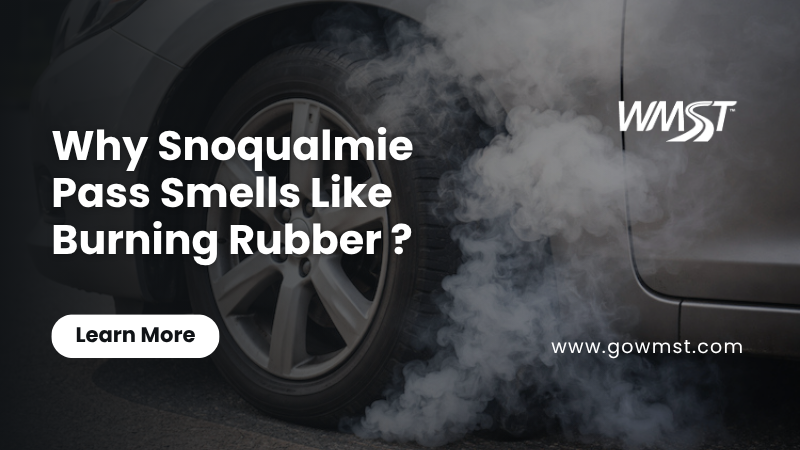
If you have ever driven westbound on Interstate 90 over Snoqualmie Pass, you have probably noticed it: a sharp, acrid smell of burning rubber and hot metal filling the cabin of your car.
That smell is the result of hundreds of drivers making the exact same dangerous mistake. As the highway descends from the summit at a 5% to 6% grade, inexperienced drivers simply ride their brake pedals for miles on end to control their speed.
This habit doesn’t just wear out your brake pads—it can lead to total brake failure. Mountain driving requires a different skill set than city cruising. Here is the WMST mountain terrain guide to driving steep downgrades WA style, and how to get to the bottom of the pass safely.
“Brake Fade”: Why Your Pedal Suddenly Goes to the Floor
Your car’s braking system relies on friction. When you press the pedal, brake pads clamp down on metal rotors. This friction creates an enormous amount of heat.
- The Boiling Point: If you ride the brakes continuously down a long mountain pass, that heat has nowhere to go. The rotors can literally glow red hot. Eventually, the brake fluid inside the lines begins to boil.
- The “Squish”: When brake fluid boils, it turns into gas. Unlike liquid, gas compresses. If this happens, stepping on the brake pedal will feel soft and squishy. In severe cases, the pedal will go straight to the floor, and the car will not slow down. This terrifying phenomenon is known as brake fade.
- The Fix: If you feel your brakes getting soft, or if your steering wheel starts shaking violently when you brake, pull over to a safe shoulder or turnout immediately. Do not keep driving. You must let the brakes cool down naturally for at least 30 minutes.
Visit: Don’t Roll Away: The Rules of Parking on Hills in WA
Downshifting an Automatic: How to Let Your Engine Do the Work
The secret to Snoqualmie Pass safe driving is avoiding the brake pedal almost entirely by using your engine to control your speed. This is called engine braking.
- Yes, Automatics Can Downshift: Many drivers think downshifting is only for manual transmissions. Almost all modern automatic cars have a way to manually select a lower gear.
- How to Do It: Before you start the steep descent, take your foot off the gas and shift your car from “D” (Drive) into a lower gear. Depending on your car, this might mean moving the shifter to “3”, “2”, “L”, or using the “-” paddle shifter behind the steering wheel.
- The Result: The engine’s natural compression will hold the car back, keeping your speed steady at 55 or 60 mph without you ever needing to touch the brake pedal. Your engine will rev higher and sound loud—this is completely normal and will not damage your car.
Runaway Truck Ramps: Why You Should Never Park in Them
As you descend Snoqualmie or Stevens Pass, you will see large dirt or gravel ramps shooting up the side of the mountain to your right. These are runaway truck ramps.
- A Lifeline for Semi-Trucks: Fully loaded logging or freight trucks weigh up to 80,000 pounds. If they experience brake fade, these arrester beds (filled with deep, loose gravel) are the only thing stopping them from causing a catastrophic accident.
- The Golden Rule: Never, under any circumstances, park in or block the entrance to a runaway truck ramp. Do not pull over there to check your phone, cool your brakes, or take pictures of the snow. A runaway semi-truck traveling at 80 mph cannot steer around you, and the results will be deadly.
How WMST Teaches Vehicle Control on 6% Grades
At WMST, we know that reading about mountain driving is very different from actually looking down a steep, winding highway.
- The “Snubbing” Technique: If you are in a lower gear but the car is still picking up too much speed, we teach the “snubbing” method. Instead of riding the brakes lightly, apply the brakes firmly to drop your speed 5 to 10 mph below the speed limit, then completely release the pedal. This gives the brakes time to cool off before you need to apply them again.
- Looking Ahead: We train drivers to read the yellow warning signs. A sign indicating a 6% downgrade for the next 5 miles is your cue to downshift before the hill starts, not halfway down when your brakes are already smoking.
Frequently Asked Questions (FAQs)
Do my brake lights come on when I use engine braking?
No. Engine braking slows the car internally. Because you are not physically pressing the brake pedal, your rear brake lights will not illuminate. This is why you must leave plenty of following distance, as the driver behind you won’t get a visual warning that you are slowing down.
Is it bad for my automatic transmission to shift into a lower gear?
No, it is perfectly safe and exactly what the manufacturer intended. Your car’s computer is smart; it will not let you downshift into a gear that would blow the engine. The loud revving noise is just the engine working as an air pump to slow the car down.
What should I do if my brakes fail on a downhill pass?
Do not panic. Immediately take your foot off the gas and downshift to the lowest possible gear (“L” or “1”). If the car is still accelerating, pump the brake pedal rapidly to try and build fluid pressure. If that fails, look for a runaway truck ramp, an ascending dirt road, or sideswipe a guardrail to scrub off speed as a last resort.
Can I use cruise control going down a mountain?
It is highly discouraged. Traditional cruise control is designed to maintain speed by accelerating, not braking. While some modern adaptive cruise control systems will actively brake for you, relying on the computer can easily lead to riding the brakes and causing brake fade. Turn it off and manage your speed manually.
What does the “L” or “B” stand for on my gear shifter?
- L (Low): Locks the transmission into the lowest possible gear. Use this for very steep, slow descents.
- B (Brake/Engine Braking): Commonly found on hybrids like the Toyota Prius. It aggressively engages the regenerative braking and engine braking specifically for long downhill stretches to save the physical brake pads.
 EN
EN  ES
ES  RU
RU  FR
FR  JA
JA  AR
AR  VI
VI