
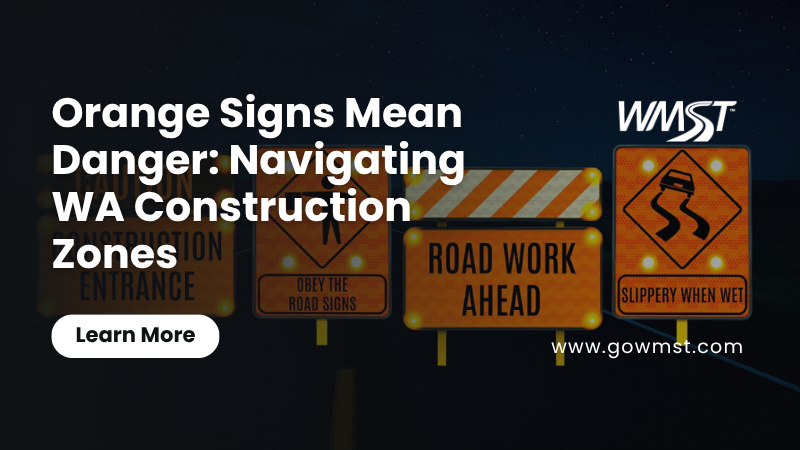
If you drive in Washington, you are familiar with the “state flower”: the orange traffic cone. From massive freeway projects on I-5 to local utility work in suburbs, construction zones are everywhere.
They are also some of the most dangerous places to drive. In WA, hundreds of work zone collisions occur annually, often because drivers are confused by the changing rules. Navigating these areas requires more than just slowing down, it requires a complete shift in awareness. This guide explains the construction zone driving laws WA enforces and how to protect both your wallet and the workers.
The “Double Fine” Reality: Speeding in Work Zones
The most famous rule of construction zones is often the most misunderstood: “Fines Double.”
- The Law: Under RCW 46.61.527, speeding in a marked construction zone results in a penalty that is twice the standard amount. A typical $150 ticket can instantly become a $300+ financial disaster.
- The “Worker” Myth: Many drivers believe fines only double if they see workers present. This is false. In Washington, if the signs are posted, the double fine applies—even at 2 a.m. on a Sunday when the site is empty. If the speed limit sign says 45 mph, doing 60 mph is a double-fine offense, period.
- No Mitigation: Judges in WA are often legally restricted from reducing fines for work zone infractions. You cannot just “talk your way out of it.”
Reading the Temporary Signs: Flaggers and Flashing Lights
Construction zones use a language of their own. Ignoring a temporary sign is just as illegal as running a red light.
- The Flagger is King: If a construction worker holding a stop/slow paddle gives you a signal, it overrides all other signs and lights. If the traffic light is green but the flagger holds a “STOP” sign, you must stop. Disobeying a flagger is a gross misdemeanor.
- Flashing Arrow Boards: These bright yellow arrows indicate mandatory lane changes. Do not wait until the last second to merge; these boards are often placed well in advance for a reason.
- “Resume Speed”: Do not speed up the moment you pass the construction equipment. You must maintain the reduced speed until you pass the specific sign that says “End Road Work” or posts a new speed limit.
Lane Shifts and Narrow Shoulders: Keeping Your Cool
Work zones often involve shifting lanes (where the painted lines weave sideways) or narrowing lanes to create space for equipment.
- The “Chute” Effect: Driving between concrete jersey barriers feels claustrophobic. The secret is to look far ahead. If you stare at the concrete wall next to your mirror, you will drift toward it. Look at the center of the lane 10 seconds ahead.
- Following Distance: Equipment like dump trucks and pavers often stops suddenly or kicks up rocks. In a work zone, increase your following distance to at least 5 seconds. This gives you a buffer if the car ahead panics at a lane shift.
How WMST Simulates Confined Space Driving
You can’t always practice in a live construction zone, but WMST hazard awareness training prepares you for the feeling of tight spaces.
- Cone Corridors: We use traffic cones to create narrow lanes in safe parking lots, forcing students to get comfortable driving with only inches of clearance on either side.
- Distraction Management: Work zones are visually loud—flashing lights, moving workers, bright signs. We train students to filter out the “noise” and focus purely on their path of travel and the vehicle ahead.
- Sudden Stops: We practice smooth braking techniques so that if traffic stops abruptly in a work zone, you don’t become part of a pile-up.
Visit: What Every Teen Driver Should Know About Car Insurance in Washington?
Frequently Asked Questions (FAQs)
Do work zone speed limits apply at night when no one is working?
Yes. Unless there is a specific sign that says “When Workers Present,” the posted reduced speed limit is active 24/7. Temporary lane shifts and uneven pavement are hazards regardless of whether workers are there.
What should I do if a flagger gives confusing signals?
Stop. If you are unsure what a flagger wants you to do, bring your vehicle to a complete stop and wait for a clear hand signal. Never guess. Roll down your window if you need to hear a verbal instruction.
How close can I get to construction equipment?
Give them a wide berth. Heavy machinery has massive blind spots. A good rule is: “If you can’t see the operator’s face in their mirror, they can’t see you.” Stay back at least 50 feet if possible.
Why are fines doubled in these zones?
It is a deterrent designed to save lives. Road crews are working inches away from speeding traffic with nothing but a plastic cone for protection. The severe financial penalty forces drivers to pay attention.
Does the driving test go through construction zones?
It can. Examiners do not avoid road work. If your test route takes you through a construction zone, you will be graded on your adherence to the temporary signs, speed limits, and your ability to watch for hazards. Speeding in a work zone during a test is an automatic fail.
 EN
EN  ES
ES  RU
RU  FR
FR  JA
JA  AR
AR  VI
VI