
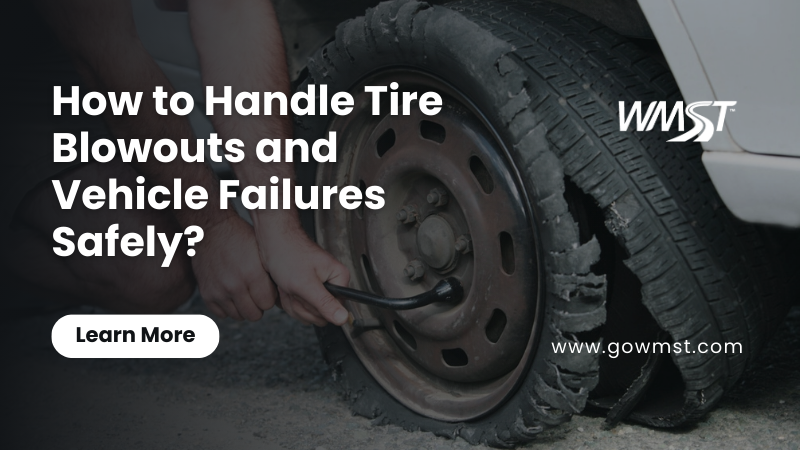
We often train for the predictable parts of driving: stop signs, lane changes, and parking. But what happens when the car itself fails you?
A tire blowout or sudden engine failure at highway speeds is terrifying, but survival isn’t about luck—it’s about physics and instinct control. For Washington drivers, knowing how to manage emergency vehicle handling WA roads require is a critical skill set. This guide breaks down exactly what to do when your vehicle malfunctions and how WMST emergency training helps you stay calm in the chaos.
Recognizing Early Signs of Mechanical Issues
Often, your car will tell you something is wrong before it fails completely. Developing “mechanical sympathy” allows you to react early.
- Vibration: A sudden, rhythmic shaking in the steering wheel often indicates a tire is losing pressure or unbalancing before it blows.
- The Sound: A loud “thump-thump-thump” is usually a flat tire. A sharp “bang” followed by a “whooshing” sound is a blowout.
- Warning Lights: Never ignore the dashboard. A flashing “Check Engine” light or a “Tire Pressure” symbol means you need to get off the road immediately, even if the car feels fine.
Steps to Maintain Control During a Blowout
If a tire explodes at 60 mph, your instinct will be to slam on the brakes. You must fight this instinct. Braking during a blowout shifts the car’s weight to the failed tire, causing you to lose control and potentially spin.
The Correct Tire Blowout Response:
- Ease off the Gas: Gradually ease off the accelerator. Do not just release the accelerator at once, as that can cause the nose to drop…
- Grip the Wheel: The steering wheel will try to jerk to the side of the blown tire. Hold it firmly with both hands (9 and 3 position) and force the car to go straight.
- Coast Down: Once stabilized, lift your foot off the gas and let the natural drag of the flat tire slow you down. Do not touch the brake until you are below 20 mph.
Visit: How to Safely Drive on Gravel Roads in Washington?
Safe Pull-Over and Emergency Response
Once you have regained control, your goal is to get off the active roadway. Roadside safety in WA is critical due to high-speed traffic.
- Signal and Move: Turn on your hazard lights immediately. Move to the right shoulder if possible. (Only move to the left median if you absolutely cannot reach the right).
- Get Far Off: Do not stop “just enough” off the line. Pull as far onto the grass or gravel as you safely can.
- Stay or Go? If you are on a busy highway like I-5, it is often safer to stay inside your vehicle with the seatbelt on than to stand on the roadside. If you must exit, climb out the passenger side, away from traffic.
WMST Techniques for Unexpected Vehicle Problems
You can’t practice a blowout on the freeway, but you can train for the reaction. WMST emergency training focuses on the mental and physical skills needed for these moments.
- Simulation Training: We use safe, controlled environments to simulate loss of traction and emergency braking, teaching students how to keep steering even when the car feels unstable.
- The “What If” Curriculum: Instructors constantly drill students on emergency escape paths. “If your engine died right now, where would you coast to?”
- Physics Education: We teach why the car reacts the way it does, so you understand the importance of not braking during a skid or blowout.
Frequently Asked Questions (FAQs)
How should I react during a tire blowout?
Do not panic and do not brake. Grip the steering wheel firmly to counter the pulling force, keep the car straight, and let it coast to a slow speed before gently pulling over.
Can beginners maintain control?
Yes, if they know the rules. The physical strength required is minimal; the challenge is overcoming the panic response. Mental rehearsal (“If this happens, I will do X”) is highly effective for beginners.
Is roadside safety taught in WA lessons?
Yes. The WA driver guide covers emergency stops. We teach students exactly how to position their vehicle on the shoulder and how to use hazard triangles or flares if they have them.
Does WMST simulate emergency failures?
We simulate the reactions. While we don’t pop tires on purpose, we practice “Command Stops” and evasive steering maneuvers that mimic the inputs you would use during a mechanical failure.
What are common mistakes during vehicle emergencies?
The two biggest errors are slamming on the brakes (causing a spin) and stopping in an unsafe location (like a blind corner or the left shoulder of a highway). Always prioritize getting out of the traffic lane over saving the rim of your wheel.
 EN
EN  ES
ES  RU
RU  FR
FR  JA
JA  AR
AR  VI
VI