
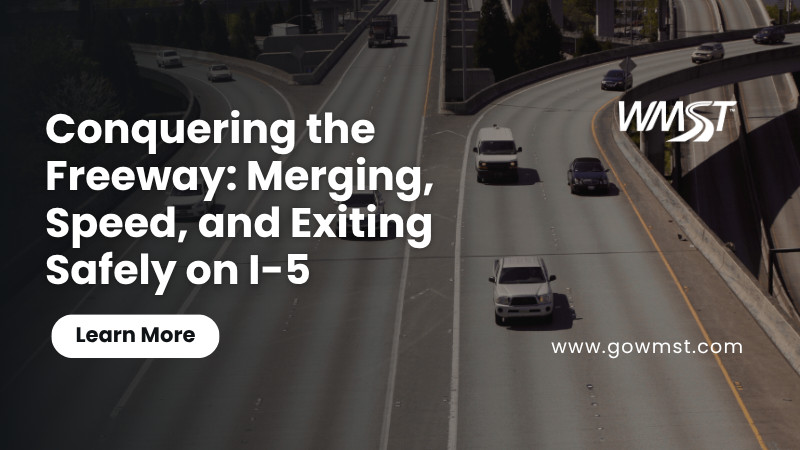
For a new driver in Washington, “I-5” isn’t just a road name—it’s a source of dread. The massive semi-trucks, the 60+ mph speeds, and the aggressive merging behavior can make the interstate feel like a battlefield.
However, freeway driving is statistically safer than city driving because everyone is moving in the same direction and there are no cross-streets. The danger usually comes from hesitation. By understanding the physics of the highway and mastering freeway driving lessons WA instructors teach, you can turn that anxiety into competence. This guide breaks down the essential skills for surviving and thriving on the big road.
Why Highway Driving Scares New Drivers?
The fear of the freeway usually boils down to two things: Speed and Space.
- Sensory Overload: At 60 mph, you cover 88 feet every second. Decisions that you have 5 seconds to make on a city street must be made in less than 1 second on the highway.
- The “Wall” of Cars: Merging feels like trying to jump into a spinning jump rope. If you don’t time it right, it feels like you’ll get hit.
- Velocitization: This is the phenomenon where, after driving at high speeds for a while, your brain gets used to the visual flow. When you exit, 40 mph feels like you are crawling, leading to dangerous speeding on off-ramps.
The “Acceleration Lane” Mistake: Why You Must Speed Up to Merge
The on-ramp is not for “looking”; it is for accelerating. The most dangerous thing a beginner can do is enter the freeway at 40 mph while traffic is doing 60 mph.
The Golden Rule of Merging: You must match the speed of the traffic before you merge.
- Hit the Gas: As soon as the ramp straightens out, press the accelerator firmly. Do not be afraid of the engine noise—you need that power.
- Pick Your Spot: Look for a gap in traffic early. Do not wait until the end of the lane to look.
- Signal and Slide: Once you are at speed (60 mph), signal and slide into the gap.
- Do Not Stop: Unless traffic is completely gridlocked, never stop at the end of an on-ramp. It is incredibly dangerous and leaves you with no room to build speed up again.
Managing Space at 60 MPH: The 4-Second Rule
On the highway, space is your shield. Tailgating is the leading cause of multi-car pileups on I-5.
The 4-Second Following Distance: Pick a landmark (like an overpass or sign) that the car ahead of you passes. Count: “One-Washington, Two-Washington, Three-Washington, Four-Washington.” If you reach the landmark before you finish counting, you are following too close.
Why 4 Seconds? At 60 mph, it takes the average human 1.5 seconds just to react to brake lights. The remaining 2.5 seconds are needed for your brakes to actually stop the car. If it is raining (common in WA), increase this to 6 seconds.
How WMST Builds Confidence for High-Speed Merges
You cannot learn to swim by reading a book, and you cannot learn driving on I-5 beginner skills in a parking lot. WMST highway training uses a graduated exposure method.
- Ramp Repetition: We practice entering and exiting the highway repeatedly. This builds the muscle memory of “Accelerate, Signal, Check, Merge.”
- Lane Change Drills: We teach students how to change lanes at 60 mph without slowing down—a common error that frustrates other drivers.
- Exit Discipline: We train you not to brake on the freeway. Instead, you maintain speed until you enter the deceleration lane (off-ramp), then brake firmly.
Frequently Asked Questions (FAQs)
What is the speed limit on I-5 for new drivers?
There is no special speed limit for new drivers. You must follow the posted limit (usually 60 mph in urban areas like Seattle/Tacoma and 70 mph in rural areas). However, Intermediate License holders must be extra careful, as a single speeding ticket can result in license suspension.
Do I have to move over for merging traffic?
Legally, no, the merging driver must yield to you. However, it is a courteous defensive driving habit. If the left lane is clear, move over to let merging traffic in safely. Note: You MUST move over for emergency vehicles on the shoulder (Move Over Law).
How do I exit safely if traffic is heavy?
Plan ahead. The “One Mile Rule” says you should be in the right lane at least one mile before your exit. Do not try to cut across three lanes of traffic at the last second. If you miss your exit, go to the next one.
Does WMST take students on the freeway during lessons?
Yes. Once a student has demonstrated good vehicle control on surface streets, we introduce highway driving. We believe it is safer to merge onto I-5 for the first time with a professional instructor’s brake pedal next to you than with a nervous parent.
What is “velocitization” and how do I avoid it?
Velocitization is losing your sense of speed after highway driving. You might think you are doing 35 mph on the off-ramp, but you are actually doing 50 mph. Avoid it by consciously checking your speedometer as soon as you exit the highway.
 EN
EN  ES
ES  RU
RU  FR
FR  JA
JA  AR
AR  VI
VI