
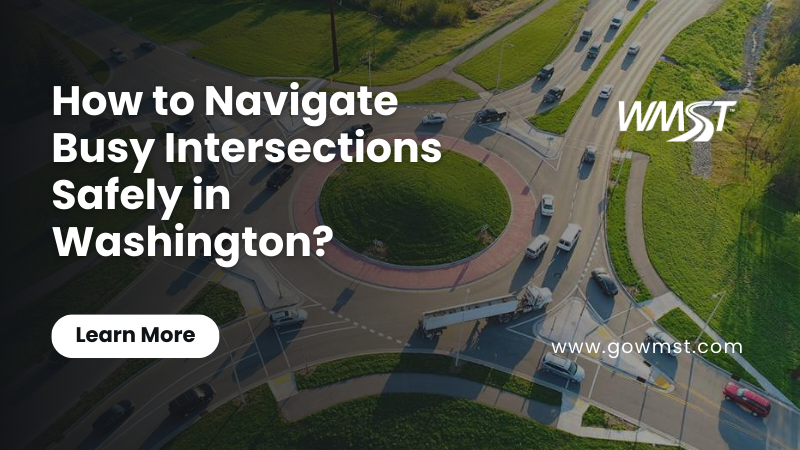
Intersections are the “decision hubs” of the road. They are where vehicle paths cross, pedestrians step out, and traffic laws are put to the ultimate test. In Washington State, nearly 30% of all serious traffic collisions occur at intersections.
For learner drivers, these areas can feel chaotic. However, chaos is just a pattern you haven’t recognized yet. By understanding the rules and knowing where to look, you can navigate even the busiest downtown junctions with calm precision. This guide covers the essentials of intersection safety WA drivers need to know.
Why Intersections Are Risky for New Drivers
Intersections are dangerous because they require multitasking. In a matter of seconds, a driver must:
- Analyze traffic lights or signs.
- Judge the speed of oncoming cars.
- Scan for pedestrians and cyclists.
- Control their own speed and steering.
For a new brain that is still learning how to simply keep the car in the lane, this sensory overload can lead to “freezing up” or missing critical details like a red light runner.
Understanding Right-of-Way and Traffic Signals
Confusion over “who goes first” is the primary cause of intersection accidents.
The 4-Way Stop Hierarchy: At a 4-way stop, the rules are rigid to prevent crashes.
- First In, First Out: The driver who stops at the line first goes first.
- The Tie-Breaker: If two vehicles arrive simultaneously, the vehicle on the left yields to the vehicle on the right.
- Straight vs. Turning: If two vehicles arrive opposite each other at the same time, the one going straight has the right-of-way over the one turning left.
Traffic Signals Guidance: Understanding traffic lights is more than just “Green means Go.”
- Solid Green Circle: You can go, but you must yield to oncoming traffic if turning left.
- Green Arrow: You have “protected” movement. Oncoming traffic is stopped.
- Flashing Yellow Arrow: You may turn left, but only after yielding to oncoming traffic and pedestrians.
Visit: Driving in the Age of EVs: What Every New Driver Should Know About Electric Cars
Tips for Making Safe Turns
Executing a smooth turn requires good observation and timing.
- Process Early: Begin identifying potential conflict way in advance of the intersection by getting your eyes up the road. Process hazards in the order in which they will arrive and have a plan for how you will respond to each hazard, if necessary. Then make adjustments to your speed, car postion and lane to minimize conflict prior to arriving at the intersection.
- The “L-R-L” Scan: Before entering any intersection (even on a green light), look Left, then Right, then Left again. The danger is most likely to come from your left first, so checking it twice is vital.
- Don’t “Block the Box”: If traffic is heavy on the other side of the intersection, do not enter. Wait behind the stop line until there is enough space for your car to clear the intersection completely. Getting stuck in the middle when the light turns red is illegal and dangerous.
- Watch for Pedestrians: Always check the crosswalk of the street you are turning onto. A pillar of the car often hides pedestrians.
Visit: Managing Multi-Lane Roads: A Beginner’s Guide to Staying in Control
How WMST Prepares Students for Real Intersections
You cannot learn intersection safety WA standards from a simulator alone. You need to see real cars and real behavior.
WMST intersection training puts you in the driver’s seat in varied environments.
- Graduated Exposure: We start with quiet 2-way stops in residential areas and graduate to complex, multi-lane signalized intersections on busy arterials.
- Commentary Driving: Instructors encourage students to narrate their observations (“I see a stale green light,” “I see a pedestrian waiting”). This builds the mental habit of active scanning.
- Defensive Positioning: We teach you where to position your wheels while waiting to turn left (keep them straight!) so you aren’t pushed into oncoming traffic if rear-ended.
Frequently Asked Questions (FAQs)
Who has the right of way at a 4-way stop?
The driver who arrived and stopped first. If it’s a tie, yield to the driver on your right.
Can I turn right on red in WA?
Yes, unless a sign specifically says “No Turn on Red.” However, you must come to a complete stop behind the line and yield to all cross-traffic and pedestrians before turning.
How do I handle congested intersections?
Patience is key. Never enter an intersection unless you can exit it. If traffic is backed up, wait at the stop line, even if you have a green light.
Does WMST use real traffic scenarios?
Yes. Our lessons take place on public roads with real traffic. We believe navigating actual busyness—delivery trucks, rush hour, and pedestrians—is the only way to build true competence.
Are intersections included in the driving test?
Absolutely. You will be tested on uncontrolled intersections, stop signs, and traffic signals. Failure to yield right-of-way is one of the most common reasons for failing the state exam.
 VI
VI  EN
EN  ES
ES  RU
RU  FR
FR  JA
JA  AR
AR