
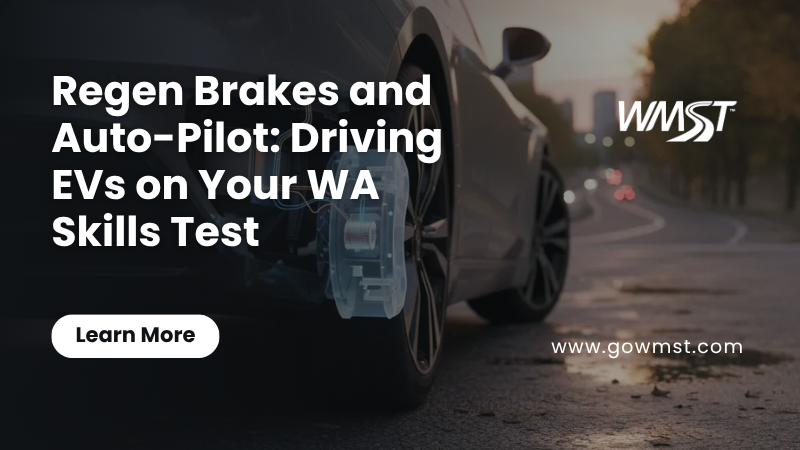
It is 2026, and electric vehicles (EVs) are everywhere in Washington State. Naturally, more students are showing up to their Washington State Department of Licensing (DOL) skills test in a Tesla, Rivian, or Mustang Mach-E.
While you are absolutely allowed to take your test in an EV, modern cars come with a hidden trap: they are too smart. The DOL driving test is designed to evaluate your ability to control the vehicle, not the computer’s ability to do it for you. Relying on your car’s advanced tech during the exam can result in heavy point deductions or an instant fail. Here is the ultimate guide to the electric vehicle driving test Washington rules and how to pass without the car driving for you.
One-Pedal Driving: Mastering Regenerative Braking Smoothness
If you drive an EV, you are likely used to “one-pedal driving.” When you lift your foot off the accelerator, the regenerative braking system aggressively slows the car down to recapture energy.
- The Testing Problem: Examiners grade you heavily on your ability to perform smooth, controlled stops. If you lift your foot off the pedal too quickly, the car will jerk abruptly.
- The Deduction: Jerky movements are a red flag for examiners and will result in point deductions for “poor vehicle control” and “improper stopping.”
- The Solution: Practice feathering the accelerator. You must learn to ease your foot off the pedal gradually so the car glides to a stop just as smoothly as a gas-powered car using a brake pedal.
Visit: What Every Teen Driver Should Know About Car Insurance in Washington?
The “Screen Distraction”: Managing Heavy Infotainment Systems
Many modern EVs, particularly Teslas, have removed physical buttons and placed everything—from the speedometer to the windshield wipers—on a massive center touchscreen.
- Eyes on the Road: The examiner is watching your eye movements closely (Scanning). If you are staring at the center screen to check your speed or figure out how to turn on the defroster, you are not looking at the road.
- The Prep: Before you put the car in drive, know exactly where your essential controls are. If it starts raining during your test, you need to be able to activate the wipers without taking your eyes off the windshield for more than a split second.
Turn Off the Tech: Why You Can’t Use Auto-Park on the Exam
Advanced Driver Assistance Systems (ADAS) are great for daily commuting, but they are your worst enemy on the DOL skills test.
- No Hands-Free Driving: Using Tesla’s Autopilot, Full Self-Driving (FSD), or any other brand’s adaptive steering/cruise control during the test is strictly prohibited. You must have physical control of the steering wheel and pedals at all times.
- The Parallel Parking Trap: Do not even think about hitting the “Auto-Park” button. The examiner wants to see you manually maneuver the car into the space. If the car parks itself, you fail that maneuver.
- Allowed Tech: Standard, passive safety features like blind-spot warning lights (on the mirrors) and standard anti-lock brakes (ABS) are perfectly fine and do not need to be disabled.
How WMST Trains Drivers to Avoid “Automation Complacency”
At WMST, we recognize that the cars of 2026 are highly advanced, but we also know that technology can fail. Our WMST electric vehicle training focuses on combating “Automation Complacency.”
- Back to Basics: We teach students how to drive the car as if the computers are offline. This means physical head checks, manual braking distance calculation, and spatial awareness that doesn’t rely on a screen beep.
- Confidence Behind the Wheel: By mastering the foundational physics of driving, our students walk into their DOL test confident that they are the one driving the car, not the other way around.
Frequently Asked Questions (FAQs)
Can I take my Washington driving test in a Tesla?
Yes. As long as the vehicle is legally registered, has valid liability insurance, and passes the basic safety inspection (working turn signals, brake lights, seatbelts, etc.), you can use a Tesla or any other EV for your skills test.
Am I allowed to use the backup camera during the parallel parking test?
You may leave the screen on, but you cannot rely on it. Washington DOL rules require you to physically turn your body and look out the rear window over your right shoulder while backing up. If you stare at the backup camera screen, you will lose significant points for “poor vision.”
Do examiners dock points for jerky regenerative braking?
Yes. The examiner is looking for safe, smooth, and predictable control. If your regenerative braking causes the car to lurch or stop far short of the intersection because you didn’t feather the pedal correctly, you will lose points for vehicle control.
What ADAS features must be disabled for the DOL skills test?
Any feature that actively controls the car must be off. This includes Auto-Park, Adaptive Cruise Control, Lane Centering/Lane Keep Assist (if it actively steers the car), and Autopilot/FSD. Passive warnings, like blind-spot chimes or collision warning beeps, can stay on.
Does WMST have electric or hybrid vehicles for practice?
Yes, ВМСТ incorporates modern vehicles into our training fleet to ensure students are comfortable with the latest vehicle dynamics, including regenerative braking and modern dashboard layouts, before they take their official test.
 RU
RU  EN
EN  ES
ES  FR
FR  JA
JA  AR
AR  VI
VI