
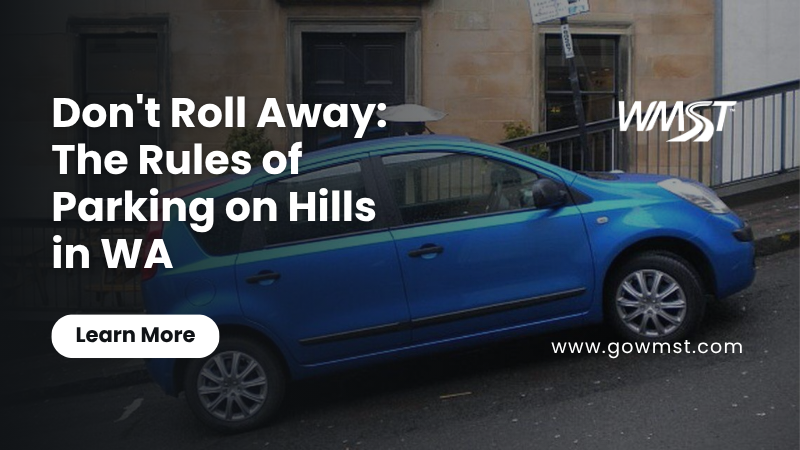
If you have ever driven in downtown Seattle or Tacoma, you know that Washington has some terrifyingly steep streets. Parking on a 20% grade isn’t just about getting the car into the spot—it’s about ensuring it stays there after you walk away.
A “runaway” vehicle is a driver’s worst nightmare, and in WA, you can be held liable if your parked car rolls into traffic. The secret to safety isn’t just your emergency brake; it is the position of your front tires. This guide explains the physics of parking on hills WA laws require and the easy mnemonics to get it right every time.
Gravity vs. Your Car: Why the Emergency Brake Isn’t Enough
Many drivers assume that putting the car in “Park” and pulling the handbrake is sufficient. On flat ground, it is. On a steep hill, it might not be.
Mechanical brakes can fail. Cables can snap, and transmissions can pop out of gear. If that happens, gravity takes over.
- The Safety Backup: By turning your front wheels specifically, you use the curb as a “chock” or wedge. If the brakes fail, the car will roll a few inches, hit the curb, and stop physically, preventing it from rolling into the intersection.
The “UCLA” Rule: Uphill Curb Left Always
This is the most important acronym you will learn for hill parking. It applies to only one specific scenario, but it is the one students mess up the most.
UCLA = Uphill Curb Left Always
- Scenario: You are facing Uphill and there is a hard Curb next to you.
- The Action: Turn your steering wheel sharply to the LEFT (away from the curb).
- The Check: Let the car roll back gently until the back of the front tire touches the curb.
- Why? If the car rolls backward, the front wheels will catch the curb and swing the nose of the car away from traffic, locking it in place.
Downhill and No-Curb Scenarios: Which Way to Turn?
If “UCLA” is the exception, what is the rule for everything else? Turn Right.
- Downhill (With Curb): Turn wheels to the RIGHT (toward the curb). If the car rolls forward, the tire hits the curb and stops.
- Downhill (No Curb): Turn wheels to the RIGHT (toward the shoulder). If the car rolls, it goes into the grass/ditch, not the road.
- Uphill (No Curb): Turn wheels to the RIGHT. If you turned left here (like UCLA), and the car rolled back, the nose would swing into oncoming traffic. By turning right, the car rolls backward away from the road.
Simple Summary: Turn wheels Right for everything, except Uphill with a Curb (Left).
WMST Drills for Securing Your Vehicle on Seattle Hills
Correct wheel direction is step one. Securing the transmission is step two. WMST parking techniques teach a specific “Securing Procedure” to save your transmission from stress.
The WMST Hill Park Method:
- Come to a complete stop and keep the foot brake held.
- Turn your wheels the correct direction.
- Shift to Neutral.
- Apply the Parking Brake firmly.
- Slowly release the foot brake to let the car settle against the parking brake (and curb).
- Once the car is holding, shift into Park (or gear). This ensures the weight of the car is holding on the brakes/curb, not on the delicate transmission pin.
Frequently Asked Questions (FAQs)
Do I fail the test if I turn my wheels the wrong way?
Yes. Parking on a hill is a scored maneuver. Leaving your wheels straight or turning them the wrong way creates a safety hazard. It is often an automatic failure or a significant point deduction on the WA DOL test.
How far from the curb can I be when hill parking?
The standard rule applies: you must be within 12 inches of the curb or road edge. Being too far out puts your car in the path of passing traffic, which is dangerous on narrow hill streets.
Should I leave my car in gear or neutral?
- Automatic: Always use “Park.”
- Manual Transmission: Leave it in gear!
- Uphill: Leave it in 1st Gear.
- Downhill: Leave it in Reverse.
- Never leave a manual car in Neutral on a hill.
What if there is no curb on the hill?
Turn your wheels to the RIGHT (toward the side of the road). You want the car to roll off the road into the dirt or grass if the brakes fail, rather than crossing the center line into traffic.
Does WMST practice on steep gradients?
Yes. We intentionally seek out hills during lessons to practice this. We want students to feel the “roll back” in a controlled environment so they learn to trust the curb.
 JA
JA  EN
EN  ES
ES  RU
RU  FR
FR  AR
AR  VI
VI