
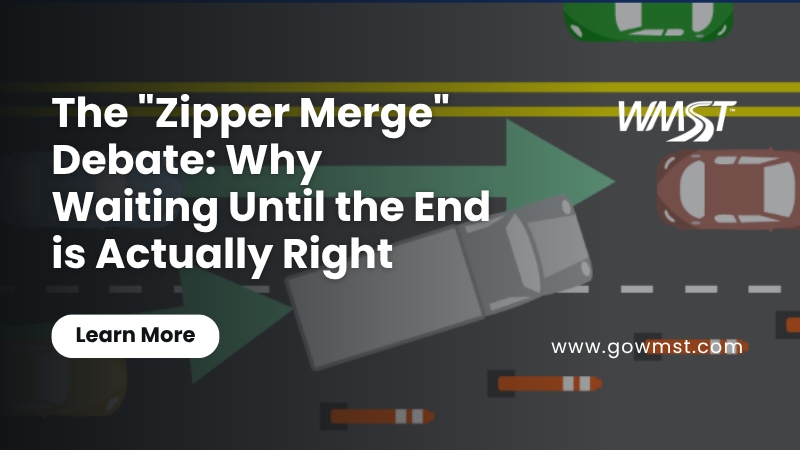
You are stuck in traffic approaching a construction zone. You merged into the open lane a mile back like a “good” driver. Suddenly, a car zooms past you in the ending lane, driving all the way to the cones before cutting in.
Your blood boils. You think they are cheating. But according to traffic engineers and the Washington State Department of Transportation (WSDOT), they are the ones doing it right, and the long line of “polite” early mergers is actually making the traffic jam worse. This concept is called the zipper merge Washington state encourages, and understanding it is key to reducing road rage and congestion.
What is a Zipper Merge? (And Why Drivers Hate It)?
The “Zipper Merge” (or late merge) occurs when drivers use both lanes of traffic until the reaching the defined merge point (usually where the lane ends), then take turns merging into the open lane in a “1-to-1” fashion—like the teeth of a zipper coming together.
Why Drivers Hate It: Most of us were taught to be polite. “cutting the line” feels rude and aggressive. Psychologically, early mergers feel like they have “paid their dues” by waiting, and they view late mergers as “cheaters” who are skipping the line. This creates a dangerous “us vs. them” mentality that often leads to road rage or vigilante blocking.
The Science: How Early Merging Causes More Traffic
When everyone merges early (a mile before the lane ends), you are essentially leaving a mile of usable road completely empty.
- Wasted Capacity: By abandoning a lane too soon, you reduce the road’s capacity by 50%. This extends the backup twice as far back as it needs to be, often blocking off-ramps or intersections miles upstream.
- The “Accordion” Effect: Early merging is chaotic. People merge at different speeds and locations, causing the open lane to brake tap constantly.
- The Zipper Efficiency: When both lanes are full and merge at a single, predictable point, traffic moves up to 40% faster. It maximizes the available asphalt and keeps the line moving steadily.
When to Zipper (and When Not To)
This is the critical nuance: The zipper merge is only for slow, congested traffic.
- Use the Zipper Merge: When traffic is heavy, slow-moving, or stopped. If you see brake lights and a “Lane Ends” sign, stay in your lane until the merge point.
- Do NOT Zipper Merge: When traffic is moving at highway speeds (freeway speed). If traffic is light and flowing freely, merging early is safer and smoother. Forcing a merge at the last second at 60 mph is dangerous and causes panic braking.
How WMST Teaches Polite but Efficient Merging?
At WMST, we teach that being “right” doesn’t help if you cause a crash. WMST traffic flow tips focus on cooperative driving.
- The “Space Cushion”: We teach drivers in the open lane to leave a constant 3-4 car lengths of space ahead. This invites the merging car in without forcing anyone to stop.
- Eye Contact and Signaling: We train students to signal early and, if possible, make eye contact or wave. It humanizes the maneuver and reduces aggression.
- Defensive Positioning: We teach students how to merge late without being aggressive—matching speed, finding the gap, and moving decisively rather than forcing their way in.
Preguntas frecuentes (FAQ)
Is it rude to drive all the way to the merge point?
No, not in heavy traffic. It is the most efficient use of the road. However, many drivers perceive it as rude, so be prepared for some unhappy looks. Just remember: you are actually helping reduce the overall backup for everyone.
Can I get a ticket for blocking a zipper merger?
Yes. Vigilante drivers who straddle the center line to block cars from passing in the passing lane are breaking the law. It is considered “Impeding Traffic” or reckless driving and can result in a hefty fine.
Does the zipper merge apply at highway speeds?
No. WSDOT advises that the zipper merge is for low-speed, congested situations. At 60 mph, you should merge as soon as you safely can to avoid disrupting the flow.
Why don’t more drivers use this technique?
It is largely habit and peer pressure. Until public education catches up, the social pressure to “get in line” overpowers the logic of efficiency.
Does WMST cover zipper merging in lessons?
Yes. We explain the difference between early vs. late merging and help students identify which technique is appropriate based on the current traffic speed and density.
 ES
ES  EN
EN  RU
RU  FR
FR  JA
JA  AR
AR  VI
VI