
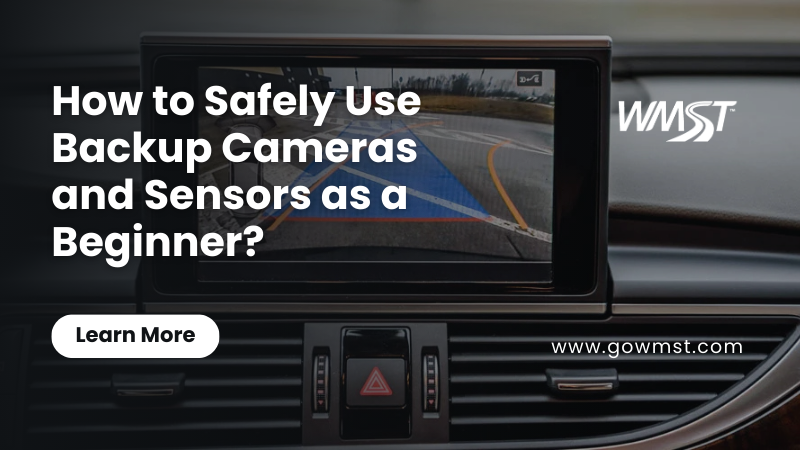
Modern vehicles are engineering marvels. With high-definition backup cameras, 360-degree bird’s-eye views, and ultrasonic proximity sensors, parking has never been technically easier.
However, for a beginner driver, this technology can be a trap. “Screen fixation”—staring solely at the dashboard while moving backward—is a dangerous habit that leads to accidents and automatic failures on the Washington driving test.
While these tools are valuable, they are aids, not substitutes for human vision. This guide explains how to integrate backup camera training WA standards require into your driving routine, ensuring you use technology to enhance safety, not replace it.
Understanding Camera and Sensor Limitations
Before you trust your life (or your bumper) to a sensor, you need to understand what it cannot do.
- The “Fish-Eye” Effect: Backup cameras use wide-angle lenses to show more area. This distorts distance, making objects appear further away than they actually are.
- The Blind Corners: Cameras look straight back. They often cannot see cars approaching from the side (cross-traffic) until you have already backed almost halfway out of the parking spot.
- Sensor Blind Spots: Ultrasonic sensors (the beeping noise) are great for walls, but they often miss thin objects like signposts, chain-link fences, or a child standing between sensors.
- Weather Interference: In Washington, rain, mud, and snow can block lenses and sensors, rendering them useless in seconds.
How to Combine Mirrors and Technology
To drive safely, you must use a “scanning loop” that incorporates all your tools. The camera should be just one part of the cycle, not the whole show.
The Pro Reversing Scan:
- 360 Check: Before moving, look all around the vehicle physically.
- Look Back: Turn your head and look out the rear window (this is mandatory for the test).
- Glance at Mirrors: Check side mirrors for lane alignment.
- Glance at Camera: Check the screen briefly to verify nothing is directly behind your bumper (like a bicycle or low wall).
- Repeat: Keep your eyes moving. Do not stare at any single view for more than a second.
Avoiding Over-Reliance on Backup Tools
The most common mistake WMST tech-assisted driving instructors see is students ignoring their surroundings because the car isn’t “beeping” at them.
- The WA Test Rule: During your DOL Skills Test, you are allowed to glance at your backup camera, but you cannot stare at it. The examiner wants to see you physically turning your head and looking out the back window. If you back up while looking only at the screen, you will likely fail.
- The “Safety Bubble”: Technology only looks backward. It doesn’t tell you if your front fender is about to scrape the car next to you as you swing out. You need your eyes and mirrors to monitor your entire vehicle footprint.
WMST Techniques for Modern Vehicle Training
We teach students to use technology as a “verification tool,” not a “navigation tool.”
- “Camera Cover” Drills: In safe practice lots, instructors may briefly cover the screen to force students to rely on their mirrors and spatial awareness. This builds the confidence that “I can park this car,” not just “The computer can park this car.”
- Sensor Calibration: We teach students to park using their eyes, then check the sensor display to see how accurate their judgment was. This helps calibrate your brain to the car’s physical size.
- Parking Technology Tips: We show students how to clean lenses and identify when a sensor is giving a false reading due to heavy rain or ice.
Preguntas frecuentes (FAQ)
Can backup cameras replace mirror checks?
No. Cameras have blind spots on the corners and distort depth. Mirrors provide a true reflection of the sides of your vehicle and are essential for avoiding scrapes against garage doors or other cars.
Are sensors reliable in all conditions?
No. Heavy rain, snow, or even thick mud can block sensors, causing them to either beep constantly (false positive) or fail to detect an obstacle at all (false negative). Always visually verify the path is clear.
Are these technologies allowed on the driving test?
Yes, you can use a car equipped with cameras and sensors for the WA DOL test. However, you must demonstrate that you are using them as an aid. If you fixate on the screen and neglect your head checks, you will be penalized.
Does WMST teach tech-assisted parking?
Yes. WMST embrace modern safety features. We teach you how to interpret the guidelines on your backup screen to judge trajectory, while simultaneously maintaining physical awareness of your surroundings.
How can beginners avoid overconfidence with sensors?
Treat the “beep” as a warning to stop and look, not a permission slip to keep moving. If the car beeps, stop immediately and visually identify the hazard. Never assume it’s “just a glitch.”
 ES
ES  EN
EN  RU
RU  FR
FR  JA
JA  AR
AR  VI
VI