
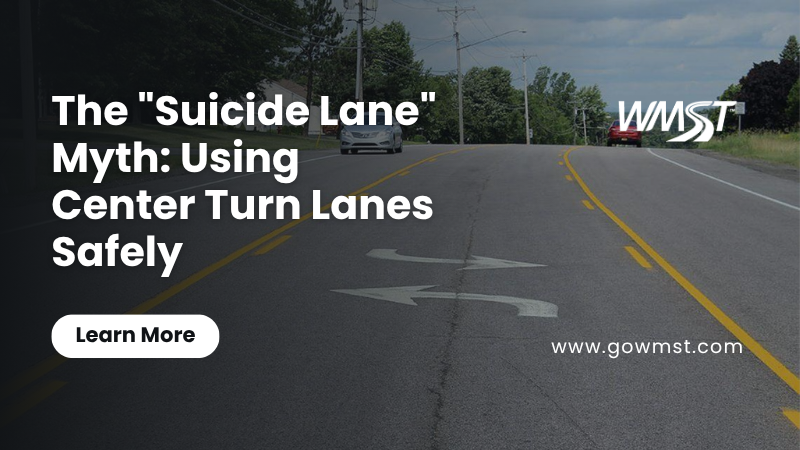
It sits in the middle of busy arterials, marked by yellow lines and seemingly used by drivers going in opposite directions simultaneously. It is the Two-Way Left Turn Lane (TWLTL), affectionately known by nervous drivers as the “Suicide Lane.”
The nickname comes from the fear of head-on collisions, but when used correctly, this lane is actually a huge safety feature. It removes slowing cars from the flow of traffic, preventing rear-end crashes. However, misusing it as a passing lane or a freeway on-ramp is illegal and dangerous. This guide clears up the center turn lane rules WA law dictates so you can navigate urban traffic with confidence.
What is a Two-Way Left Turn Lane?
First, you need to identify it correctly. A center turn lane is marked by solid yellow lines on the outside و dashed yellow lines on the inside. This means you can cross the line to enter the lane, but it is not a normal travel lane.
Do Not Confuse with Reversible Lanes: Some busy streets (like Aurora Ave in Seattle) have “Reversible Lanes” marked by double-dashed yellow lines. These change direction based on the time of day and are controlled by overhead lights.
- Green Arrow: You can use the lane.
- Red X: Get out immediately!
- Steady Yellow X: The lane is about to reverse; vacate it now. Always look up for reversible lane signs before entering a lane with double dashed markings.
The “300-Foot Rule”: How Long Can You Drive in the Center?
The most common ticket issued related to center lanes is for driving in them too long. In Washington State (RCW 46.61.290), it is illegal to travel more than 300 feet within the center turn lane.
- The Length of a Football Field: 300 feet is roughly the length of a football field.
- Don’t Coast: You should only enter the lane when you are close to your turn. Do not enter the center lane three blocks early just to bypass traffic.
- No Passing: You can never use this lane to pass a slow-moving bus or truck. It is strictly for turning.
Entering Traffic vs. Exiting Traffic: Who Has Priority?
The center lane serves two purposes:
- Turning OFF the road: Slowing down to enter a driveway or side street (Exiting).
- Turning ONTO the road: Waiting in the center to merge into traffic (Entering).
Merging from Center Lane: Using the center lane to enter traffic is legal in WA, but it is an advanced maneuver.
- Turn left from the side street into the center lane.
- STOP. You are now protected from traffic on the right, but you must wait for a gap in traffic on the right to merge in.
- Check for “Suicide” Drivers: Before you pull into the center lane, ensure no one coming from the opposite direction is already using it to turn left.
The Priority Rule: generally, a driver already established on the main road (turning off) has right-of-way over a driver trying to enter the road from a driveway.
WMST Drills for Mastering the Center Lane
In our WMST urban lane training, we see students freeze up when asked to use these lanes. We build confidence through specific drills:
- The “Gap Guard”: We teach students to scan for oncoming cars قبل entering the center lane. If an oncoming car has its blinker on, do not share the lane—wait your turn.
- Precision Entry: We practice entering the lane smoothly at 25 mph rather than stomping the brakes in the through lane (which causes rear-end accidents).
- The “Merge Stop”: We drill the technique of turning into the center lane, coming to a complete stop, and then merging into the flow of traffic only when safe.
Visit: How to Handle Aggressive Drivers Safely in Washington
الأسئلة الشائعة (FAQs)
Can I use the center lane to pass a slow car?
No. This is a moving violation. The center lane is exclusively for left turns. Using it to overtake a vehicle is illegal and highly dangerous.
Is it legal to accelerate in the center turn lane?
No. It is not an acceleration lane (like a freeway on-ramp). While you may need to build some speed to merge into traffic, using it to race up to 40 mph to cut in front of cars is reckless driving.
Who yields if two cars want the same spot in the center lane?
If you and an oncoming car both want to enter the center lane, the car that is not crossing a lane of traffic generally has priority, but in reality, it is a shared space. Eye contact is key. If the other driver is already moving into the lane, let them have it.
What do double yellow dashed lines mean?
These indicate a Reversible Lane. Do not treat this as a standard turn lane unless overhead signs indicate it is currently a center turn lane (often denoted by a yellow “two-way turn” arrow). If there is no sign, assume it is a through lane for one direction only.
Does the driving test cover center turn lanes?
Yes. If your test route includes a busy arterial, the examiner will expect you to use the center lane to turn left into a business or side street. Failing to enter the lane (turning from the through lane instead) is a critical error.
 AR
AR  EN
EN  ES
ES  RU
RU  FR
FR  JA
JA  VI
VI